
The Skill That Will Define Your Career in 2026
Why mastering “what” and “why” matters more than ever in the age of AI
The Three Layers of Every Job
Here’s a framework I’ve been thinking about: every job, every role, every task you do breaks down into three fundamental layers.
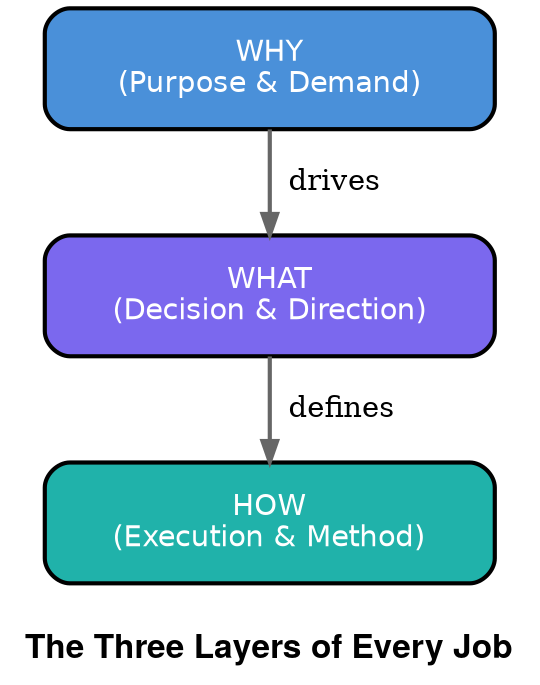
Why
The purpose. The demand. The reason something needs to exist.
What
The decision. The direction. Choosing what to build, what to solve, what to prioritize.
How
The execution. The method. The implementation details.
These layers aren’t new. They’ve always existed. But AI is fundamentally reshaping how value is distributed across them.
AI Is Rapidly Solving the “How”
Let’s be clear about what’s happening: AI is getting exceptionally good at the “how” layer.
Write code? AI can do it. Generate a marketing email? Done. Create a design mockup? Handled. Summarize a document, analyze data, build a prototype, all increasingly within AI’s reach.
This isn’t speculation. It’s already here. Teams are shipping AI-generated code at scale. Content is being produced faster than ever. The execution layer is being automated.
But here’s what most people miss about this shift.
The “What” Is Hard for AI
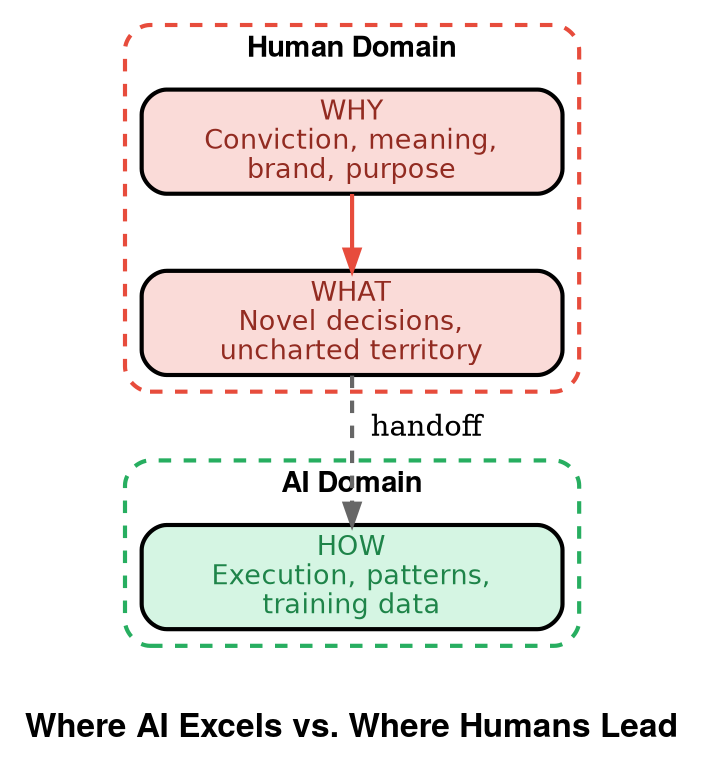
The “what” layer is deciding what to build, what problem to solve, what direction to take, remains stubbornly difficult for AI.
Why?
Because “what” decisions often involve something that has never been done before. They require judgment calls in ambiguous situations. They demand understanding of context that doesn’t exist in any training dataset.
Think about it: the “how” has been done a million times. There are patterns, best practices, documented solutions. That’s exactly what makes it trainable.
The “what” is the opposite. It’s novel. It’s contextual. It’s the space where you’re making decisions without a playbook.
The “Why” Is the Moat
If “what” is hard for AI, “why” is nearly untouchable.
The “why” is what makes people care before a product even exists. It’s conviction. It’s meaning. It’s the foundation of every brand, every movement, every product that ever mattered.
AI can help you build faster. It can optimize, iterate, and execute at scale.
But it can’t wake up one day and decide something needs to exist. It can’t tell you what’s worth building. It can’t create demand from nothing.
That’s a human act.
This Isn’t New, It’s Just the Next Abstraction Layer
We’ve seen this pattern before.
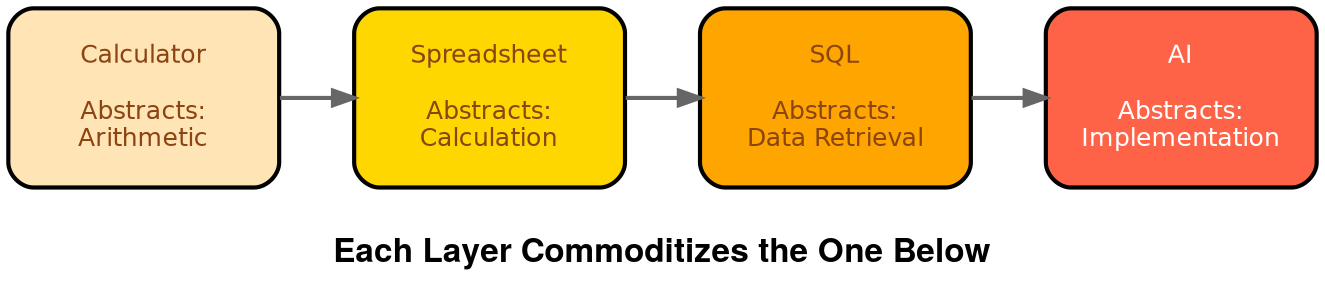
When calculators arrived, you stopped needing to know how to multiply. You only needed to know why and what to calculate.
When spreadsheets emerged, manual calculation became obsolete. The value shifted to knowing what questions to ask of the data.
When SQL made data retrieval accessible, the competitive advantage moved to understanding what insights mattered.
AI is doing the same thing abstracting away the “how” and pushing value upward to “why” and “what.”
The people who thrived at each transition were the ones who moved up the stack quickly. The pattern hasn’t changed.
What This Means for Software Engineers
Software engineering has always been heavy on the “how” side.
Write the code. Implement the solution. Ship the feature.
That’s exactly the part getting commoditized fastest.
The engineers who will thrive aren’t the ones with the most elegant implementations. They’re the ones who can look at a problem and say:
- “We shouldn’t build this at all.”
- “The real problem is upstream.”
- “Here’s what actually matters.”
That’s a “what” skill. And critically, it’s learnable.
The Uncomfortable Truth
Most software engineering training, hiring, and career ladders are still optimized for “how.”
We interview for algorithms. We promote for shipping. We reward lines of code and features delivered.
The incentive structures haven’t caught up to the reality.
The engineers who recognize this shift early and deliberately cultivate “what” skills =will have a significant advantage. Not because “how” skills become worthless, but because they become table stakes. The baseline. The commodity.
Where to Position Yourself
The most valuable skill won’t be prompting AI. It won’t even be building AI systems.
It will be mastering the “why” and “what”, the layers that remain distinctly human.
Until AI can solve the “why,” humans are safe.
But if your job is mostly about “how,” I’d move up the stack.
Fast.
How to Develop “What” Skills
Moving from “how” to “what” isn’t about abandoning technical depth. It’s about expanding your perspective. Some practical approaches:
Ask “should we?” before “how do we?” - Train yourself to question whether a solution is worth building before diving into implementation.
Understand the business context - Know why your work matters to customers, to revenue, to the company’s strategy. The “what” becomes clearer when you understand the “why.”
Practice saying no - The ability to kill bad ideas early is a “what” skill. It requires confidence and judgment.
Embrace ambiguity - “What” decisions rarely have clear right answers. Get comfortable making calls with incomplete information.
Spend time with customers - Understanding real problems, not just technical specifications, shifts your thinking from execution to direction.
The big picture here isn’t that different from the past. Technology has always added abstraction layers on top of jobs.
AI is just adding the next one.
The question isn’t whether this shift is coming. It’s whether you’ll be ready for it.